The model
Human Agile Model™
We forgot people come before the product. Human is the architecture. A generic, worldwide operating overlay for organization transformation. Adapt, Implement, and Scale only run when the human gate passes.
This model is for any organization adapting agile and AI together: private, public, federated, or multi-country. It aligns with Agile and responsible AI standards, embeds alongside Scrum, SAFe, and your existing operating model, and keeps human focus at the center. Published specification with copyright and trademark protection. I am Anjish Bhondwe.
What this model is
Organizations are made of humans who receive, deliver, and change. Transformation programmes treat them as headcount while agile and AI reshape how work runs.
This is a generic operating overlay for organization transformation: the same human gate, four moves, and Index apply whether you run software delivery, shared services, or a federated enterprise. It aligns with Agile and responsible AI standards, embeds alongside Scrum, SAFe, and your existing operating model, and is published for worldwide reference under copyright.
Premise
Humans at the center
People receive change, deliver through it, and change because of it. The Human Agile Model puts them back in the design.
Problem
Dark Agile
Agility performed for dashboards, not practiced with humans inside. Burnout, silence in retros, and attrition treated as individual failure, not design failure.
What it is not
Not a rollout product
Not a timeline or consultancy package. A human-focus lens you embed in the transformation you already run.
Worldwide, generic transformation
The Human Agile Model is jurisdiction-neutral. Receiver, deliverer, and changer describe any organization where humans carry change: engineering firms, banks, retailers, public agencies, and multi-country programmes. The human gate and four moves do not depend on one industry, one country, or one scaling framework.
Generic solution. Use it as the human-focus layer in your operating model or transformation office. When dashboards look fine and people do not, this gives sponsors a repeatable way to name harm, pass the gate, and re-check at scale.
Easy to understand. Like Scrum or SAFe, the model keeps a small teachable core: five gate questions, four moves, five operating rules, and eight Index questions. Teams can learn it in a workshop and apply it in the next retro, PI planning session, or governance review.
Field interviews that shaped this model ran across telecom, financial services, retail, and technology. The specification is published for worldwide reference. See standards alignment and how to embed the overlay in what you already run.
Scope
Any organization
Private, public, federated, or multi-country. Software delivery, shared services, or enterprise change programmes.
Core
Small teachable set
Five gate questions, four moves, five rules, eight Index questions. Learned like Scrum roles and events, applied in your next review.
Reference
Published specification
Canonical web version, downloadable PDF, Figure HF-1, and copyright and trademark notice for research and adoption.
With human, for human
In the rooms I work in, leaders already know when dashboards look fine and people do not. This model is my proposal for that reality, where agile and AI transformation run together and people belong in the design from the start.
With human means receivers, deliverers, and changers help shape the work rather than receive announcements about it. Honest feedback counts as learning.
For human means subtracting harm before adding process, reading burnout as a design signal, and scaling in a way that keeps the people who did the work.
Research figure
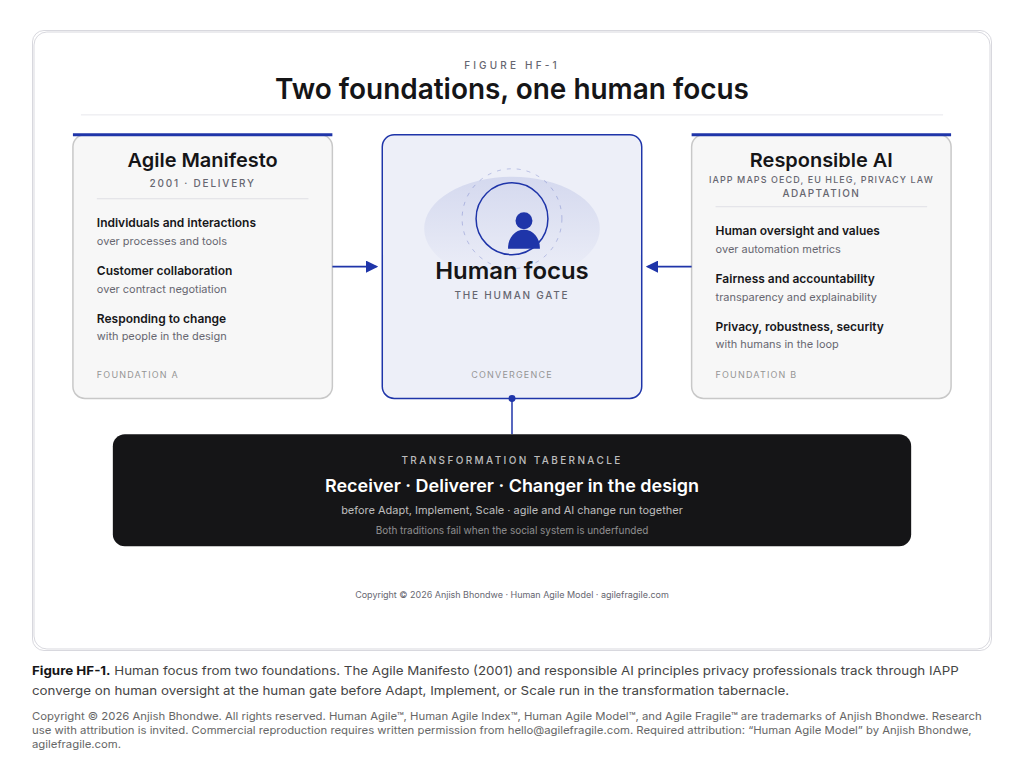
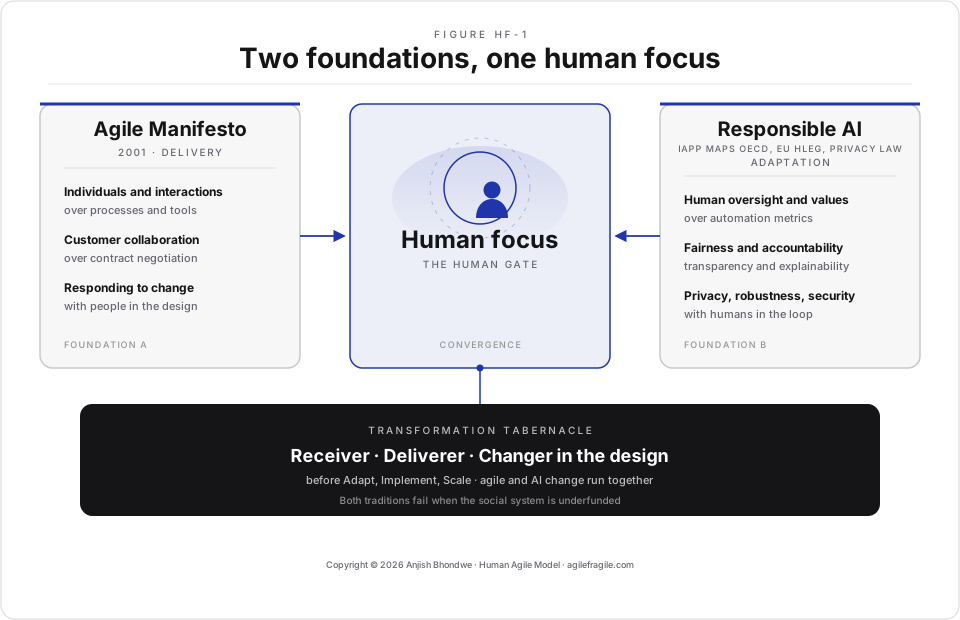
Two foundations, one human focus
The Agile Manifesto (2001) and the responsible AI principles privacy professionals track through IAPP name the same architecture from different decades. Delivery puts individuals and interactions before processes and tools. AI governance puts human oversight, human values, fairness, and accountability before automation metrics.
I did not merge them to write a third manifesto. I merged them because enterprises run agile and AI together under the transformation tabernacle, and both lineages fail the same way when the social system is underfunded.
Foundation A
Agile Manifesto (2001). Delivery tradition. People before process.
Human gate
Both arrows converge here. Receiver, deliverer, and changer in the design.
Foundation B
Responsible AI (IAPP maps OECD, EU HLEG, privacy law). Adaptation tradition.
Agile and responsible AI standards
The Human Agile Model is a unique human-focus overlay. It does not replace global standards. It gives transformation sponsors a practical way to show how their programme meets Agile delivery ethics and responsible AI requirements where the human gate, four moves, and Index apply.
Agile
Manifesto, Scrum, SAFe
Individuals and interactions first. Empiricism, respect, and transparency in the human gate, operating rules, and Index. Complements Scrum teams and SAFe trains without replacing them.
Responsible AI
OECD, UNESCO, IAPP
Human oversight, fairness, accountability, and privacy through receiver, deliverer, and changer in the design. Maps the principles IAPP tracks across OECD, EU HLEG, UNESCO, and privacy law.
Governance
EU AI Act, NIST, ISO
Human oversight and transparency checkpoints for high-risk AI contexts. Aligns with NIST AI RMF Govern-Map-Measure-Manage and ISO/IEC 42001 human-centred AI management practices.
Full mapping table: downloadable specification (PDF), section 15.
Where this draws from
I did not invent this from scratch. The model stands on published work: socio-technical systems, psychological safety, culture as leadership work, people as a first-order driver of delivery, and human-centered design.
That lineage runs from the Agile Manifesto and the responsible AI principles IAPP maps across OECD, EU HLEG, and privacy law, through Edmondson, Schein, Cockburn, and Jeffries on what breaks people when ceremony or automation becomes oppression. See two foundations, one human focus. The downloadable specification maps each source to the human gate, Index, and four moves if you need the full table.
Embed in your operating model
You do not rip out Scrum, SAFe, ITIL, COBIT, or your transformation playbook. You add the human-focus layer where change is designed and scaled.
Where to embed. Sprint and PI retros (human gate Q5). PI planning and backlog refinement (receiver and deliverer in the room). Transformation office and change advisory boards (four moves as a review cycle). AI governance and risk forums (Dark AI patterns, human oversight before scale).
How teams adopt it. Run the Index once for a baseline. Answer the five gate questions before the next wave. Work Adapt, Implement, and Scale as a cycle when pressure returns. Re-check every time someone says scale.
Assessors and transformation firms can embed the licensed module in existing maturity models. See partnership summary (PDF) and industry path.
Embed 1
Retro and planning
Human gate and Index in team retros, PI planning, and backlog sessions you already run.
Embed 2
Transformation office
Four moves as the review cycle for programme boards and change advisory groups.
Embed 3
AI governance
Human oversight checkpoint before AI scale. Dark, forced, and fake AI named alongside agile patterns.
Embed 4
Operating model
Human as architecture in your capability map. Product and delivery as evidence the architecture holds.
A path to follow
Start with an honest read of human practice rather than another rollout deck, then pause at the human gate before Adapt, Implement, or Scale run.
Name that agile and AI change run together, run the Human Agile Index with leaders and teams, answer the five human gate questions, and work the four moves as a cycle when pressure returns. Re-check every time someone says scale.
If this matches what you see in the room, get in touch. For research or audit partnerships, see the partnership summary (PDF).
Human is the architecture
Human is not step one on a slide. Everything else hangs on it.
Receives
Who receives
Customers, users, downstream teams, business units asked to adopt. Back in the journey, not an afterthought.
Delivers
Who delivers
Engineers, product teams, operators carrying the day job plus the transformation. Back in the room, not on a velocity chart.
Changes
Who changes
Leaders, coaches, enablement, HR, programme offices. Their behavior is part of the design, not above it.
The human gate
No move runs until people are in the design, not on the receiving end of a timeline.
Before Adapt, Implement, or Scale, answer these together. If the answer is no, stop adding process.
Are the people who will receive and deliver this change in the room when it is designed?
Is agile being built with teams, or pushed on a programme schedule?
Can teams reject ceremony that does not help?
Are dashboards for learning, or for judgment?
When honest feedback surfaces in a retro, is it heard or punished?
Take the Human Agile Index for a baseline read on these questions.
The four moves
A cycle you re-run as pressure returns. Each move has a purpose, activities, outputs, and a gate question.
Move 1
Human: see reality
Purpose: Name who is hurting, excluded, or about to be pushed. Encourage before you push. No framework shopping yet.
Activities
- Run the Human Agile Index with leaders and teams
- Listen for what dashboards hide: fear, overload, performative agility
- Map receivers, deliverers, and changers for this rollout
Outputs
- Named pain and blind spots
- Baseline Index score (Dark / Transitional / Human Agile)
- Agreement on who must be in the room from here
Gate: Will leadership hear unfiltered signal from people?
Move 2
Adapt: strip harm
Purpose: Figure out what is actually broken here, not what the playbook says. Subtract Dark Agile theater before you add anything new.
Activities
- Audit ceremony load on top of the day job
- Reset leader behavior: enable, do not hover
- Define what human agile means in your federated context
Outputs
- List of practices removed or simplified
- Leader commitments on psychological safety
- Local working agreement teams can keep
Gate: Can teams reject what does not help without career risk?
Move 3
Implement: co-build
Purpose: Build change with the teams in the room. Leaders help. They do not track. Receiver and deliverer both shape the design.
Activities
- Co-design rituals and flows with delivery teams
- Shift dashboards from judgment to learning signals
- Train for understanding, not checkbox compliance
Outputs
- Practices teams chose and can sustain
- Visible leader enablement, less programme surveillance
- Retro formats where honesty is safe
Gate: Is the change built with people, not done to them?
Move 4
Scale: re-humanize
Purpose: Grow across business units without losing the people who made it work. Each new rollout re-opens the human gate.
Activities
- Spread patterns, not performative copies of what looked good on slides
- Re-run the Index as budgets tighten and speed returns
- Keep community and peer space for honest conversation
Outputs
- Federated playbook with human checkpoints built in
- Rhythm for re-checking the Index at each unit
- Attrition and engagement watched as design signals
Gate: Are the people who made it work still in the design?
Explore the four moves interactively
Human: see reality
Name who is hurting, excluded, or about to be pushed. Encourage before you push.
Gate: Will leadership hear unfiltered signal from people? Take the Index
Adapt: strip harm
Figure out what is actually broken here. Subtract Dark Agile theater before you add anything new.
Gate: Can teams reject what does not help without career risk?
Implement: co-build
Build change with the teams in the room. Receiver and deliverer both shape the design.
Gate: Is the change built with people, not done to them?
Scale: re-humanize
Grow across business units without losing the people who made it work.
Gate: Are the people who made it work still in the design?
Five rules that hold the model
Simple commitments that keep Dark Agile from creeping back in.
Encourage before you push
Change earns trust. Timelines do not replace it.
Subtract before you add
Strip theater, surveillance, and harm before scaling ceremony.
Learn, do not judge
Dashboards surface signal for adaptation, not punishment.
Leaders enable
Sponsors in the room. Not hovering above the retro.
Re-check at scale
Every new rollout passes the human gate again.
The divide
Dark Agile breaks people to hit dates. Human Agile builds with them to last.
Dark Agile
- Headcount, not humans
- Framework bought before people consulted
- Dashboards that judge
- Retros for tracking
- Burnout is your problem
- Best people quietly leave
Human Agile
- Receiver, deliverer, changer in the design
- Built with people, not rolled out at them
- Dashboards for learning
- Retros where honesty is safe
- Burnout is a design signal
- Scale keeps the people who made it work
What agile actually said
Individuals and interactions over processes and tools. Listed first for a reason.
Working software is proof that humans collaborate well, not a substitute for putting them in the design.
How enterprise agile drifted
The drift. Product first. People later. The full Manifesto intent vs enterprise today audit is on the home page. Budget and strain charts are on leaders. Below is the three-stage pipeline this model responds to.
Stage 1
Customer-centric
Agile sold as customer focus. Listen sooner. Ship what matters.
Stage 2
Product-centric
Velocity took over. Dashboards. Output. People turned into numbers.
Stage 3
Human-centric
Who receives it. Who builds it. Who changes the system.
Human vs product
Human is the architecture. Product is the evidence.
Product tells you what shipped. Human tells you whether it will last.
Human lens
- Listed first in the manifesto
- Trust, agency, and psychological safety
- Burnout read as a design signal
- Dashboards for learning
Product-only lens
- Velocity and output on every slide
- Teams as headcount, not humans
- Burnout treated as individual failure
- Green charts while best people leave
Human Agile Index
Eight questions on human practice. No velocity or delivery KPIs. A high delivery score with a low human score is still Dark Agile.
0–40%
Dark Agile
Agility performed for dashboards. People paying the price.
41–70%
Transitional
Human not forgotten, but delivery pressure still breaks people in places.
71–100%
Human Agile
Humans in the design. Outcomes can last because the system does not eat its builders.
Scoring method
Each question scored 0 to 3. Maximum: 24. Percentage = (sum ÷ 24) × 100.
- Are people in the room when agile change is designed?
- Is agile built with teams, or pushed on a timeline?
- Do people feel valued in the transformation?
- Are dashboards for learning or judgment?
- Is burnout a design problem or a people problem?
- Can teams reject ceremony that does not help?
- Do leaders enable teams or track and report?
- Does agile work for your people, not against them?
How to use this
Start with a diagnosis. Read the field notes. Walk the moves. Tell me what resonates.
Step 3
Walk the moves
Use the four moves above in your next transformation review.
Terminology
Defined terms used in this specification.
- Human Agile
- Receiver, deliverer, and changer in the design. Agility practiced with humans inside.
- Dark Agile
- Agility performed for dashboards. Burnout and attrition treated as individual failure.
- Forced agile
- Transformation dictated by budget and timeline. Adoption pushed without agency. Deliverers carry the programme on top of the day job.
- Fake agile
- Ceremony and reporting without human practice. Teams comply in meetings and reject the system in the room.
- Dark AI
- AI performed for board slides and efficiency metrics, not practiced with humans inside. Headcount reduction treated as success while deliverers absorb the risk.
- Forced AI
- AI adoption dictated by mandate and timeline. Copilot licenses rolled out without training, safety review, or agency.
- Fake AI
- AI theater without human practice. Prompt templates and usage quotas without skill building or honest feedback loops.
- Transformation tabernacle
- The combined agile and AI transformation enterprises run today. Incomplete without each other. Under scrutiny because humans are at the core.
- With human, for human
- Design ethic: co-design with the people who carry change; outcomes that protect the people the change serves.
- Human gate
- Five checkpoint questions before Adapt, Implement, or Scale.
- Receiver · Deliverer · Changer
- Who receives change, who delivers through it, who changes the system.
- Four moves
- Human, Adapt, Implement, Scale. A cycle, not a waterfall rollout.
- Human Agile Index
- Eight-question diagnostic. Bands: Dark Agile, Transitional, Human Agile.
Intellectual property
Copyright © 2026 Anjish Bhondwe. All rights reserved.
Publication readiness. This model is published as a unique methodology: canonical web specification, downloadable PDF, Figure HF-1 artwork, Human Agile Index instrument, and partnership licensing terms. Copyright © 2026 Anjish Bhondwe. Human Agile™, Human Agile Index™, Human Agile Model™, and Agile Fragile™ are trademarks with applications pending. Required attribution: “Human Agile Model” by Anjish Bhondwe, agilefragile.com. Commercial embedding or adaptation requires written permission.
Trademarks. Human Agile™, Human Agile Index™, Human Agile Model™, and Agile Fragile™ are trademarks of Anjish Bhondwe. Trademark applications are pending. These marks identify the model, diagnostic, and brand published at agilefragile.com.
This page and the downloadable specification (PDF) are the published expression of the Human Agile Model on Agile Fragile. Copyright protects the text, terminology, diagrams, and structure. It does not protect abstract ideas or the Agile Manifesto (2001).
Figure HF-1. The human focus foundations diagram at #figure-hf-1 is original artwork copyright © 2026 Anjish Bhondwe. Downloadable as PDF, PNG, or SVG for research papers. You may reproduce it with the required attribution and a link to agilefragile.com/model.html#figure-hf-1. Commercial use requires written permission from hello@agilefragile.com.
Human Agile Index. The Index is a proprietary diagnostic instrument. Research use is invited under a non-exclusive license with attribution. Commercial reproduction, adaptation, or competing instruments based on these questions require written permission from hello@agilefragile.com.
Partnership. Universities, assessors, and enterprises can partner under a licensed module, research pilot, or advisory shape. Download partnership summary (Markdown) · PDF
You may link and quote brief excerpts with attribution. Reproduction or commercial use of the specification, Index, or site copy requires written permission.
Required attribution: “Human Agile Model” by Anjish Bhondwe, agilefragile.com
Measure where you are
The Index is the diagnostic built for this model.